Wednesday, August 23, 2006

Please...Call Me Crash

I hafta get up on my soapbox for a few minutes.

There's a problem with the way we talk about incidents where a vehicle collides with something, causing damage, injury or death. The problem is that we call such an event an "accident." Why would I think this a problem? Madison's longtime bicycle-pedestrian coordinator explains:
Dictionary definitions aside, the common connotation of the term accident is something that was unavoidable, unplanned, unpredictable, unpreventable, etc. In common usage, the term accident implies that no one was responsible for what happened. Most traffic crashes, however, are both predictable and preventable.
[...]
Calling these incidents crashes or collisions allows us to get away from the blamelessness that the term accident implies, and get on with the task of addressing the human behaviors that lead to these occurrences on a predictable basis so that they can be prevented.

He goes on to point out that the State of Wisconsin has recognized this mistake a long time ago:
Wisconsin DOT statistics indicate that something on the order of 80% + of reported traffic accidents are caused by driver error. In the 1989 edition of Wisconsin Traffic Accident Facts, at the bottom of page 1, is the following:

Accidents to be called Crashes

Traffic crashes are not accidents, but avoidable events caused by a single variable or chain of variables. We are dedicated to reducing traffic injuries and fatalities by addressing the factors that cause them. During this transition year, the 1989 edition of Accident FACTS uses the term "accident." Future editions will incorporate "crash" into the text and will be entitled Crash FACTS.

Here's an example of how crashes are not accidents, an incident relayed by a local alderperson:

[The Public Information Officer] of the East Police Precinct called me early this morning to report on a motorcycle-van crash which occurred at about 9:30 pm Friday night at the corner of Atwood and Jackson streets. The crash resulted in the death of the motorcyclist and critical injury to the van driver. As of this morning, the van driver, a woman, was in critical condition.

Police spotted 3 motorcyclists driving west on E. Washington Avenue at 100 MPH. Police gave chase, and two of the motorcyclists pulled over. The third continued at a high rate of speed toward the downtown. Near downtown, another squad began the chase, and the motorcyclist turned (I don't know where), got onto Williamson St., and began driving east. The police officer ceased pursuit at about Baldwin.

The motorcyclist continued onto Atwood. Police do not know how the driver collided with the van.

Chuck Strawser from the Wisconsin Bicycle Federation had this to say in response to some e-mail traffic on a local cycling list that referred to this event as an "accident":

Please stop using the word "accident" to describe "crashes." This is a horrible tragedy, but it wasn't an "accident." It's a clear example of why most crashes are NOT accidents—a motorcyclist evading police and driving at 100 MPH is almost inevitably going to end up crashing. There's nothing unpredictable, and certainly nothing unpreventable, about it.

One of the first steps to changing the culture that seems to think it's normal for drivers to kill more than 40,000 people a year, and seriously injure half a million more, is to change the language. Crashes are not accidents. (OK, it's possible that some tiny percentages of crashes fit the common understanding of the word "accident," but that doesn't mean it's OK to call all of the crashes that are predictable and easily predictable "accidents").

If you don't think that language matters, then consider "defense of marriage" vs. anti-gay legislation, and "Right to Life" vs "Pro Choice." Wherever you stand on those polarizing issues, it is absolutely clear that language matters, and when it comes to CRASHES, the Wisconsin Department of Transportation agrees. [see above]

Also read Mr. Strawser's excellent Capital Times op-ed on a similar topic.

I often wonder how our heavy dependence on motorized transportation is not widely viewed as a major public health issue. One might think that an average of 42,000 fatalities and 3.2 million injuries per year due to crashes alone would warrant some outrage. Of those numbers, about 6000 of the fatalities and 120,000 of the injuries are not occupants of motor vehicles involved. Pedestrians, bicyclists and just about everybody else is at risk of great bodily harm. Consider also that "motor vehicle crashes are the leading cause of death for every age from 3 through 33 years old." I'm not exaggerating—all of this information and more is readily available in painstaking detail on the NHTSA Web site.

Where is the concern, much less outrage, commensurate with the sheer volume of death on US highways? I just don't see it. Why not?

It's in large part because we excuse these incidents by describing them with a word that absolves anyone involved of responsibility. Having caused a motor vehicle crash once, I can tell you that it was a thoroughly awful experience. As unintentional as it was, it was equally preventable, and my fault for not paying closer attention. So my reflex upon hearing about a fatal crash is to feel some empathy for the person who precipitated it. I think it's also perfectly natural to think to one's self that it could have been me, because it could happen to any of us.

But empathy alone is not an appropriate response to the consequenses of motor vehicle crashes. The only meaningful first step toward addressing this huge public health and safety issue is to to stop treating it as if it cannot be addressed. Inattention, intoxication, deficient knowledge of the rules, scofflaw attitudes, whatever the reason, none of it is excusable, and we should stop treating it in word and by enforcement of law as if it were. Where else in our society do we allow such deadly force to be misused with so little consequence?

As part of the Ghost Bikes campaign, the Bicycle Federation of Wisconsin is offering this sticker, as well as stickers bearing the Ghost Bikes image. Click on it to find out how to get your paws on one.
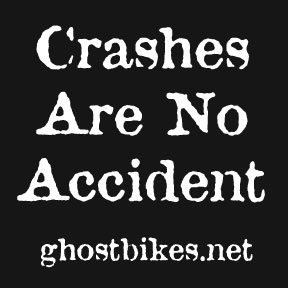


And remember, the word of the day is: "crash"

Time to get off this soapbox. It's hot up here.

Saturday, August 12, 2006

Connecting the Dots

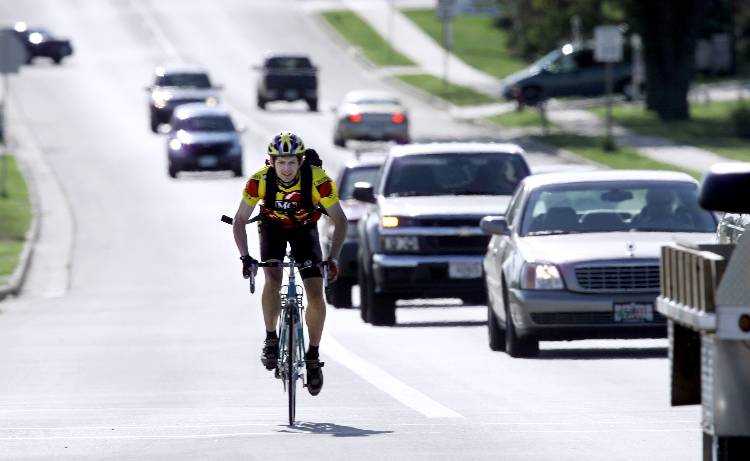
Score another front-page article for Madison cyclists, complete with a big, full-color, above-the-fold photo:

This time the article is about including bicycle facilities as a natural part of the transportation infrastructure. My friend and neighbor Andy is the featured cyclist—that's him in the photo.
"Many people think I am either stupid, insane, or foolish for riding busy roads to Sun Prairie," said Swartz.

"This should not be the case. I should have routes to use that would not lead people to that conclusion. . . . We need safe routes to (Sun Prairie) and other destinations for the novice and average rider in all conditions, the temperature, precipitation, light and hour of day."
Certainly the ideal for any bicycle commuter, but there's more to it:
"Look at it this way," Swartz added, "there is the obesity epidemic, land-use decisions, private property rights, public transportation costs, gasoline prices. They are all integrated. With gas (headed toward) $4 a gallon, people will start thinking twice before they build."
I was a little surprised to see those quotes in print...

Friday, August 11, 2006

New Kid on the Block

I've been working this week on finishing Xtracycle number 2, a mid-90's GT Karakoram:

It's set up with a Surly 1 x 1 disk fork, Hayes disk brakes, Sun Rhyno Lite/XT wheels and Nitto Albatross bars. A pretty good combination so far.

The GT frame is not suspension-corrected, but the Surly fork is—which has a surprisingly positive effect on its handling. Large Marge suffers from the same heavy steering that many folks have said comes with stock Xtracycle conversions. I've measured the relative heights of the rear axles and Boss Hogg bolts (where the Xtracycle connects to the rear dropouts of the donor bike) and found that the GT has an axle height of 13 inches and a BH height of 13.625 inches. Marge also has an axle height of 13 inches, but her BH height is only 13.125 inches. One might have thought that keeping the Boss Hoggs at the same height as the original rear axle would be the ideal, but now I'm thinking that might not the case. It's hard to know whether the fork by itself makes the difference, but I'm thinking I might like to try the Surly fork on Marge (because I'd like to convert it to disk brakes anyway.) I'm guessing that raising the front end will improve Marge's handling much in the same way it has improved the handling of the GT.

There's also the issue of GT's frame design, which I like quite a bit in spite of its goofiness. It has a noticeably harsher ride which I hope will translate to improved torsional stiffness with a load of cargo on board. The Trek 830 (Marge) has a disconcerting whippiness at low speeds with a heavy load. The handling improves considerably once it reaches 7 or 8 mph, but I'm glad I've never had to make an evasive maneuver while carrying buckets of sand or the like.

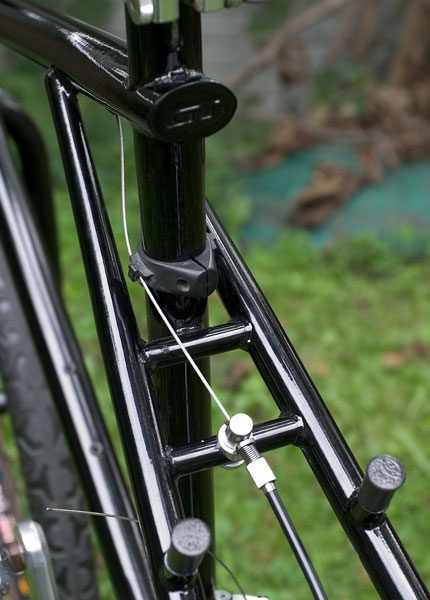
And than there's the cable routing for the rear brake:

...which is just a bolt from a post-type cantilever brake, bolted to the seatstay bridge as a stop, with a barrel adjuster added as a ferrule. Ended up being pretty clean, really.

Now I just need to add a few little things like grips, a bell, and the Xtracycle racks to finish up. I'll post pictures of the final product...

Tuesday, August 01, 2006

A Must-Read

An excellent Chicago Tribune series entitled " A Tank of Gas, a World of Trouble" takes a fascinating and well-researched look at the world of petroleum production and consumption. Reads a bit like a novel (in a good way) and is by far the most comprehensive and honest traditional print media story I've read to date. Highly recommended. (Tip 'o the hat to Ka-Bar)

See also Jane Bryant Quinn's op-ed that appeared in Newsweek. (Previously blogged by yours truly here.)

Wednesday, July 19, 2006

More Thoughts About Cars and Bikes

As a follow-up to the Ghost Bikes post from last week, I'm posting a column that appeared in the latest issue of Sustainable Times. It was written by Bob Allen, the same guy who wrote the Cargo Bikes article that appeared here and in the Sustainable Times back in April. He does a pretty darn good job of expressing what I'm sure a lot of cyclists are feeling, including me...

Cars Are Like Glass Houses


By Robert Allen

Bicycles are for transportation, not personal transformation. Riding a bicycle won’t turn a sinner into a saint.

But this doesn’t stop some motorists from expecting more than normal human behavior from every bicycle rider they see.

Anti-bicyclist letters to the editor in local papers are becoming drearily common, denouncing all who dare ride bicycles because of the antics of a rude and careless few. Of course, such letters are a benign and preferable form of backlash compared to the aggressive messages delivered along the road by some impatient motorists.

But I wonder why the letter writers, or anybody, would think bicyclists should be held to a higher standard than the rest of society.

Of course some bicyclists are rude and dangerous and they are wrong when they act selfishly and stupidly.

Riding a bicycle can help you shed pounds, save on gas and have more fun -- but it’s not going to change the content of your character. If you’re a rude and selfish jerk before you get on your bicycle, you’ll probably remain one no matter how many miles you ride.

People who focus their invective on bicyclists seem curiously complacent when it comes to dangerous and distracted motorists, who pose a much bigger threat to the health and welfare of any community.

Motorists are armed with tons of metal capable of much higher speed. The simple physics of the equation spells trouble. Add distractions like the scourge of cell phone addiction to this motorized mix and there are plenty of reasons for concern, if not a Sisyphusian stream of angry letters.

But there is something about the sight of a lone bicyclist blowing through a stop sign that sends the motoring public over the edge.

Perhaps it’s because bicyclers who ignore stop signs seem to be saying to the world that they think they’re above the law.

It’s a point well taken. Bicycles have an equal right to the road in Wisconsin, and with that right comes the responsibility to observe the same laws motorists occasionally observe.

But while I don’t condone it or recommend it, I know why bicycle riders are reluctant to scrub all the speed they’ve worked to build up at stop signs guarding empty intersections.

They aren’t doing it to thumb their noses at the world. They roll through intersections when the coast is clear because the cost of stopping for bicyclists is more directly felt than it is by drivers.

For a bicyclist, starting from a dead stop requires a considerable physical effort, much more exertion than simply maintaining pace. A driver who stops merely has to press down on the gas pedal a bit and, Bob’s your uncle, you’re back up to speed (never mind the extra blast of hydrocarbon emissions you’ve just delivered).

This isn’t an excuse, but maintaining hard-earned momentum is a compelling reality for the self-propelled.

A stop sign, however, means stop. It shouldn’t be treated like a yield sign.

I do my best to make a point of stopping fully, especially when being observed, not just because it’s the law; as a bicycling advocate, I try to be a decent ambassador out there on the road.

Not that my efforts to ride lawfully and courteously are going to change anybody’s mind. Courteous riders, like courteous drivers, are certainly in the majority. They just aren’t the ones anybody notices.

There are all kinds of people riding bicycles and driving cars. The next time one of them does something foolish, don’t hold it against the rest of us.

Allen is a commuting and recreational bicycler who lives in Middleton.


Thanks Bob.

Monday, July 17, 2006

Heat Wave


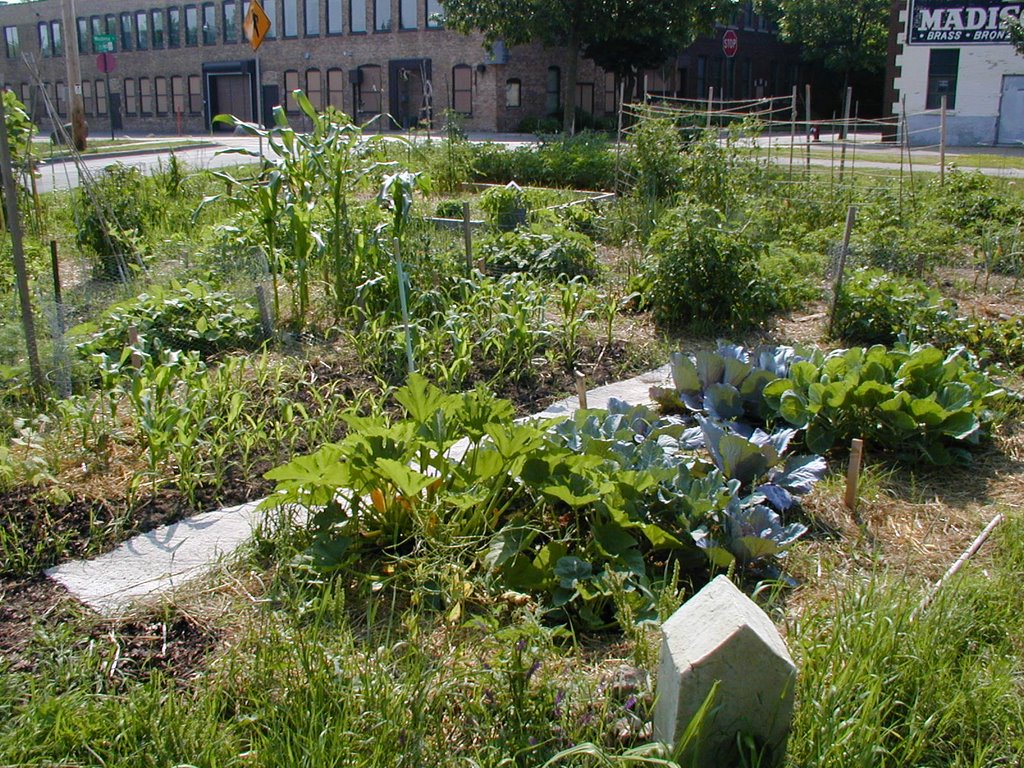
Here it is, the 2006 community garden space. Some things are doing better than others, but nothing was an outright failure. So far I've gotten radishes, lettuce, broccoli, peas (lots of peas) beets, kohlrabi, onions, carrots and summer squash. Not much in the way of quantity (except for the peas) but lots of lessons learned. Lessons like don't plant corn where you've just buried a large quantity of coffee grounds:

The rest of the corn was knee-high or better when this was shot, and this stuff wasn't past your ankle. I suppose I should know better than that, but part of the purpose of having this garden is to learn. Too much nitrogen, and probably too acidic. I'll compost the grounds thoroughly before digging them in next time.

The corn that was planted in the regular soil is doing pretty well, especially now that we've had a couple of 90-degree days. The indian corn is about 8 feet high and the sweet corn is almost 3 feet high. The soybeans, bush beans (Top Crop and Masal) are just about ready to be picked, and the bush beans I planted around the 4th of July are doing reasonably well also. Tomatoes and peppers will soon be ready. No rain predicted until Wednesday.

Wednesday, July 12, 2006

Ghost Bikes


It was me. I designed these lovely signs, which cropped up all over Dane County on about June 23. They're part if a public awareness campaign launched by the Bicycle Federation of Wisconsin.

Since I have a reputation as an avid cyclist, quite a number of people asked for explanations. I told most of them that it really amounts to asking motorists to please pay attention to what there're doing, in hopes that fewer cyclists will be killed and injured in traffic crashes.

Invariably, the response was some variation on "but...cyclists violate traffic laws all the time!" Okay, fine. I'm sure that's true. But just the same, there are plenty of law-abiding cyclists who are just at much at risk when it comes to inattentive driving. No one involved with the ghostbikes.net project is asking that anyone be allowed to violate any traffic regulations with impunity. If some cyclists violate the law, how does that vindicate motorists who violate the law?

I think there's a common willingness among people who drive regularly to overlook the asymmetrical consequences of car-bike collisions. The harsh reality is that inattentive motorists are far more likely to kill than inattentive or even scofflaw bicyclists. That's really a hard one for many folks to swallow.

Funny though, how when a truck driver reaches for his fallen cigarettes, plows into a car and kills a 4-year old and her grandmother, he gets time behind bars. Somebody looks down his throat in his rear-view at highway speed and kills a 30-year old cyclist? Hung jury. Where's the sense in that?

Saturday, June 03, 2006

Bicycle Gardening Helper


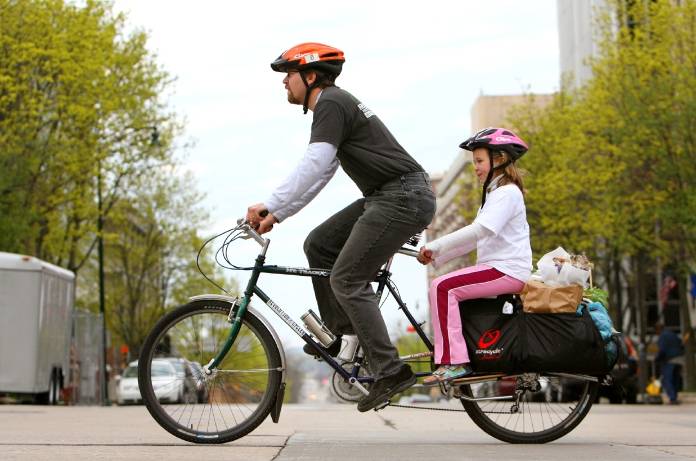
At about 80 pounds, she was a nice addition to this load, which also included 30-some-odd pounds of compost in 2 plastic buckets, 25 feet of 24-inch chicken wire, some stakes, a shovel, some scissors and the watering can. A little more than we usually haul, but not by much. Good thing the trip doesn't include a bunch of hills...

Tuesday, May 16, 2006

I Love a Parade


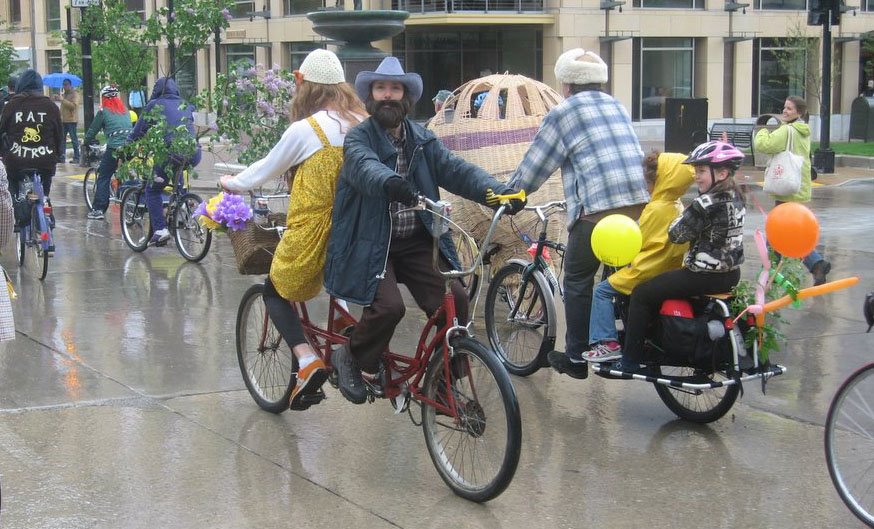
Our whole family participated in this past weekend's kickoff for Bike to Work Week, the Madison Art Bike Parade. That's us behind the push-pull tandem—I'm wearing the sheepskin hat and that's my daughter and a friend taking advantage of Marge's ample passenger accomodations.

Of course, the disadvantage to having Bike to Work Week in May is that it can rain quite a bit here in the springtime, and Saturday was no exception. The parade's trophy winner had a bit of a problem with the wooden axles of his bike swelling, which slowed his forward progress quite a bit. The maker of the Peeps bike also found herself with a different, though no less vexing dilema. But everybody soldiered through with good humor and it ended up being quite a bit of fun. Looking forward to a more creative entry next year...

Monday, May 08, 2006

Cargo Bikes, Part 2


Lightning strikes again.

Increasingly sophisticated bicycles are being designed to transport people as well as the accoutrements of their daily lives. Special bicycles and tricycles can haul items such as furniture and building supplies. And they're catching on in bicycle-friendly cities such as Madison.


It was front page, above the fold. Fantastic.