Wednesday, July 19, 2006

More Thoughts About Cars and Bikes

As a follow-up to the Ghost Bikes post from last week, I'm posting a column that appeared in the latest issue of Sustainable Times. It was written by Bob Allen, the same guy who wrote the Cargo Bikes article that appeared here and in the Sustainable Times back in April. He does a pretty darn good job of expressing what I'm sure a lot of cyclists are feeling, including me...

Cars Are Like Glass Houses


By Robert Allen

Bicycles are for transportation, not personal transformation. Riding a bicycle won’t turn a sinner into a saint.

But this doesn’t stop some motorists from expecting more than normal human behavior from every bicycle rider they see.

Anti-bicyclist letters to the editor in local papers are becoming drearily common, denouncing all who dare ride bicycles because of the antics of a rude and careless few. Of course, such letters are a benign and preferable form of backlash compared to the aggressive messages delivered along the road by some impatient motorists.

But I wonder why the letter writers, or anybody, would think bicyclists should be held to a higher standard than the rest of society.

Of course some bicyclists are rude and dangerous and they are wrong when they act selfishly and stupidly.

Riding a bicycle can help you shed pounds, save on gas and have more fun -- but it’s not going to change the content of your character. If you’re a rude and selfish jerk before you get on your bicycle, you’ll probably remain one no matter how many miles you ride.

People who focus their invective on bicyclists seem curiously complacent when it comes to dangerous and distracted motorists, who pose a much bigger threat to the health and welfare of any community.

Motorists are armed with tons of metal capable of much higher speed. The simple physics of the equation spells trouble. Add distractions like the scourge of cell phone addiction to this motorized mix and there are plenty of reasons for concern, if not a Sisyphusian stream of angry letters.

But there is something about the sight of a lone bicyclist blowing through a stop sign that sends the motoring public over the edge.

Perhaps it’s because bicyclers who ignore stop signs seem to be saying to the world that they think they’re above the law.

It’s a point well taken. Bicycles have an equal right to the road in Wisconsin, and with that right comes the responsibility to observe the same laws motorists occasionally observe.

But while I don’t condone it or recommend it, I know why bicycle riders are reluctant to scrub all the speed they’ve worked to build up at stop signs guarding empty intersections.

They aren’t doing it to thumb their noses at the world. They roll through intersections when the coast is clear because the cost of stopping for bicyclists is more directly felt than it is by drivers.

For a bicyclist, starting from a dead stop requires a considerable physical effort, much more exertion than simply maintaining pace. A driver who stops merely has to press down on the gas pedal a bit and, Bob’s your uncle, you’re back up to speed (never mind the extra blast of hydrocarbon emissions you’ve just delivered).

This isn’t an excuse, but maintaining hard-earned momentum is a compelling reality for the self-propelled.

A stop sign, however, means stop. It shouldn’t be treated like a yield sign.

I do my best to make a point of stopping fully, especially when being observed, not just because it’s the law; as a bicycling advocate, I try to be a decent ambassador out there on the road.

Not that my efforts to ride lawfully and courteously are going to change anybody’s mind. Courteous riders, like courteous drivers, are certainly in the majority. They just aren’t the ones anybody notices.

There are all kinds of people riding bicycles and driving cars. The next time one of them does something foolish, don’t hold it against the rest of us.

Allen is a commuting and recreational bicycler who lives in Middleton.


Thanks Bob.

Monday, July 17, 2006

Heat Wave


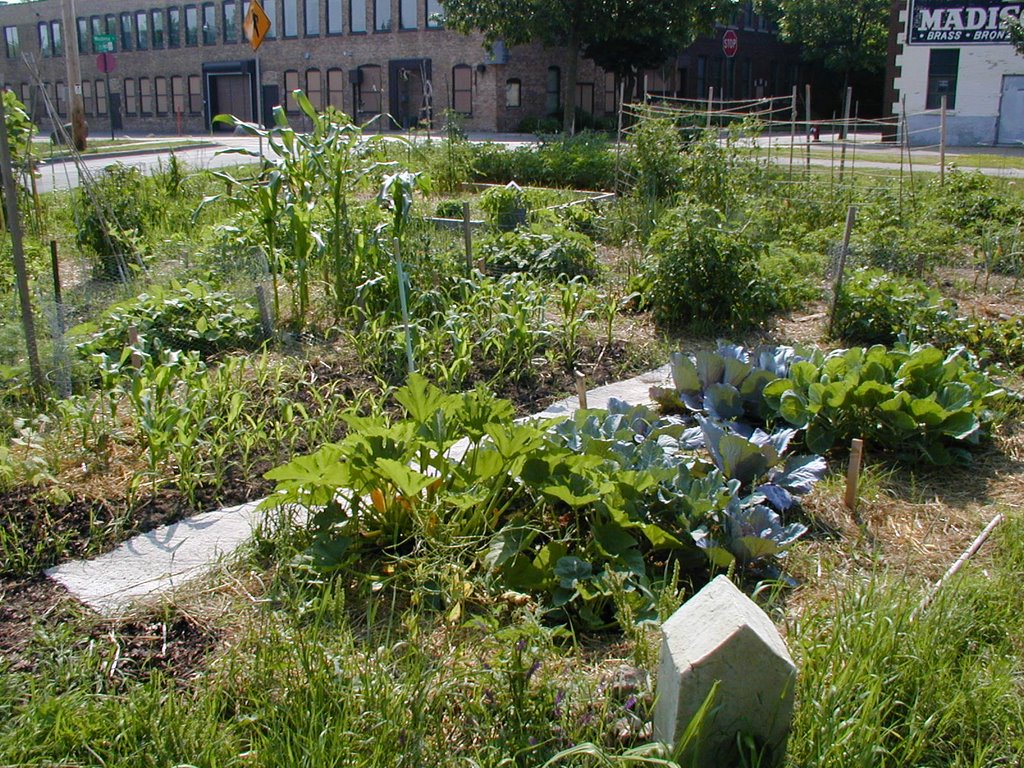
Here it is, the 2006 community garden space. Some things are doing better than others, but nothing was an outright failure. So far I've gotten radishes, lettuce, broccoli, peas (lots of peas) beets, kohlrabi, onions, carrots and summer squash. Not much in the way of quantity (except for the peas) but lots of lessons learned. Lessons like don't plant corn where you've just buried a large quantity of coffee grounds:

The rest of the corn was knee-high or better when this was shot, and this stuff wasn't past your ankle. I suppose I should know better than that, but part of the purpose of having this garden is to learn. Too much nitrogen, and probably too acidic. I'll compost the grounds thoroughly before digging them in next time.

The corn that was planted in the regular soil is doing pretty well, especially now that we've had a couple of 90-degree days. The indian corn is about 8 feet high and the sweet corn is almost 3 feet high. The soybeans, bush beans (Top Crop and Masal) are just about ready to be picked, and the bush beans I planted around the 4th of July are doing reasonably well also. Tomatoes and peppers will soon be ready. No rain predicted until Wednesday.

Wednesday, July 12, 2006

Ghost Bikes


It was me. I designed these lovely signs, which cropped up all over Dane County on about June 23. They're part if a public awareness campaign launched by the Bicycle Federation of Wisconsin.

Since I have a reputation as an avid cyclist, quite a number of people asked for explanations. I told most of them that it really amounts to asking motorists to please pay attention to what there're doing, in hopes that fewer cyclists will be killed and injured in traffic crashes.

Invariably, the response was some variation on "but...cyclists violate traffic laws all the time!" Okay, fine. I'm sure that's true. But just the same, there are plenty of law-abiding cyclists who are just at much at risk when it comes to inattentive driving. No one involved with the ghostbikes.net project is asking that anyone be allowed to violate any traffic regulations with impunity. If some cyclists violate the law, how does that vindicate motorists who violate the law?

I think there's a common willingness among people who drive regularly to overlook the asymmetrical consequences of car-bike collisions. The harsh reality is that inattentive motorists are far more likely to kill than inattentive or even scofflaw bicyclists. That's really a hard one for many folks to swallow.

Funny though, how when a truck driver reaches for his fallen cigarettes, plows into a car and kills a 4-year old and her grandmother, he gets time behind bars. Somebody looks down his throat in his rear-view at highway speed and kills a 30-year old cyclist? Hung jury. Where's the sense in that?

Saturday, June 03, 2006

Bicycle Gardening Helper


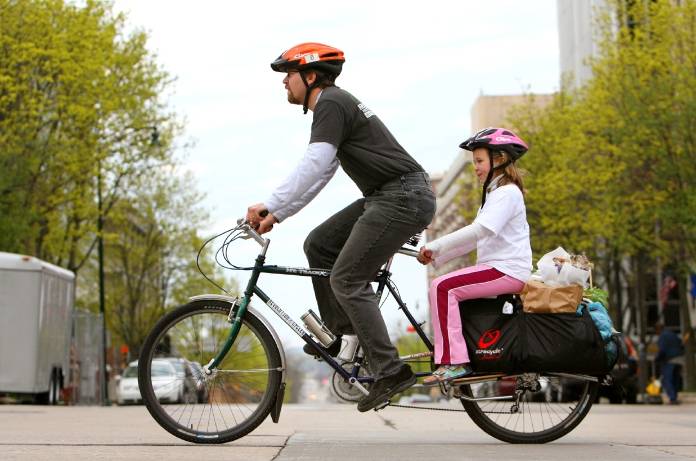
At about 80 pounds, she was a nice addition to this load, which also included 30-some-odd pounds of compost in 2 plastic buckets, 25 feet of 24-inch chicken wire, some stakes, a shovel, some scissors and the watering can. A little more than we usually haul, but not by much. Good thing the trip doesn't include a bunch of hills...

Tuesday, May 16, 2006

I Love a Parade


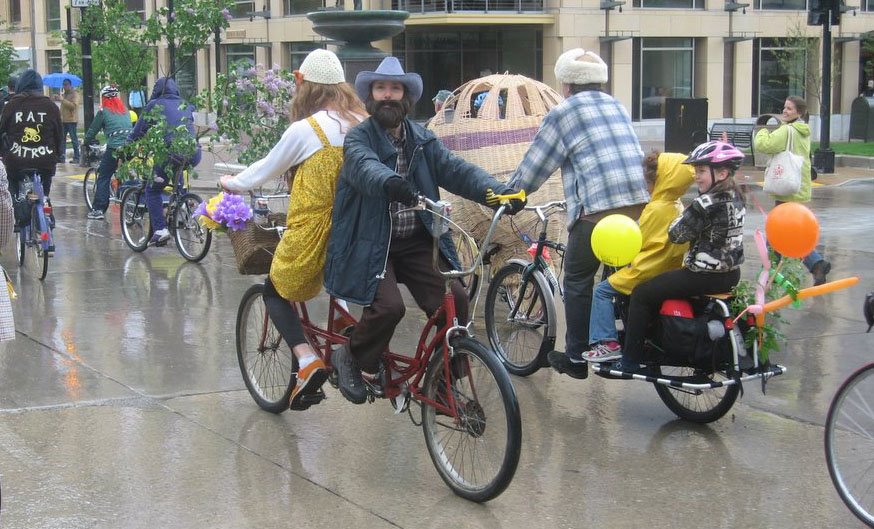
Our whole family participated in this past weekend's kickoff for Bike to Work Week, the Madison Art Bike Parade. That's us behind the push-pull tandem—I'm wearing the sheepskin hat and that's my daughter and a friend taking advantage of Marge's ample passenger accomodations.

Of course, the disadvantage to having Bike to Work Week in May is that it can rain quite a bit here in the springtime, and Saturday was no exception. The parade's trophy winner had a bit of a problem with the wooden axles of his bike swelling, which slowed his forward progress quite a bit. The maker of the Peeps bike also found herself with a different, though no less vexing dilema. But everybody soldiered through with good humor and it ended up being quite a bit of fun. Looking forward to a more creative entry next year...

Monday, May 08, 2006

Cargo Bikes, Part 2


Lightning strikes again.

Increasingly sophisticated bicycles are being designed to transport people as well as the accoutrements of their daily lives. Special bicycles and tricycles can haul items such as furniture and building supplies. And they're catching on in bicycle-friendly cities such as Madison.


It was front page, above the fold. Fantastic.

Thursday, April 27, 2006

Gardens and Art

We've gotten a community garden space recently, and we decided that it needed to have some art. So, my wife has been taking some ceramics courses in the Art department at the University. One of the grad students created an installation that used something like 200 of these clay houses. Each one is about a foot square, 30 inches tall and weighs a good 25 pounds. The show was several months ago, and the houses were slated to be tossed in the dumpster. Of course, we had to have them. We've had about a dozen sitting in the driveway for quite some time, so it was time to cart them off to the garden:


Pretty easy load for the Xtracycle, and plenty of room left for tools. Much better than the first load, which included two 20-some-odd pound buckets of compost. But really, even that wasn't that bad. As long as the two sides are balanced, it'll really haul a lot. The weather is still too cold for the city to turn on the taps at the garden, but my rain barrels have been full. So I've also hauled several loads of water, to the tune of about 10 gallons per trip. That's about 83 pounds and works fine—even if the buckets slosh a bit, the bike still handles OK.

Here's a shot of the houses arriving to find their fellows already in place:


Factory and bike path in the background.

What is it about gardens and art that they go so well together?

Wednesday, April 19, 2006

Peak Oil Hits the Mainstream

Wow. I was thumbing throught the print edition of Newsweek today and ran across something that shocked me. It was an op-ed by Jane Bryant Quinn about peak oil that didn't use the words "peak oil" at all:

The U.S. lives in an energy trap. We fell into it gladly, dug it deeper and sit fat and happy, with blinders on. We're fed daily meals of imported oil, from countries we pay in IOUs and think we can push around. But now we're starting to see the costs and risks of our dependency—and I don't only mean gasoline averaging $2.74 a gallon at the pump.

For years to come, we'll be in the hands of some of the most dysfunctional governments in the world. Oil prices will rise and economic growth will slow—not this year, but almost certainly a few years out. We'll be paying in both treasure and blood, as we fight and parley to keep ever-tighter supplies of world oil flowing our way.

What has changed in the world? We're running out of the capacity to produce surpluses of oil. Demand for crude is expected to rise much faster than new supplies. Developing nations, such as China and India, are glugging barrels at astounding rates. Meanwhile, most producer nations can't find enough new oil, or drill out more from their reserves, to replace what we're using up. Production from most of the large, older fields is in irreversible decline. [Emphasis added]


This ain't commondreams.org or the Sierra Club web site...it's Newsweek. It's not like she soft-peddles it either:

On paper, we have alternatives, such as liquefied coal, oil sands from Canada and ethanol. But they're not anywhere close to production on a massive scale. For a smooth transition, mega-energy projects need to get started at least 20 years before oil supplies decline, writes Robert Hirsch of the consulting firm SAIC in a study prepared for the U.S. Department of Energy. If we don't get a running start on the problem, he says, "the economic consequences will be dire." We're probably already behind. It takes leadership to address a potential crisis in advance.

Unfortunately, we're investing in war, not in crash projects to develop new energy sources. Maybe there's time to spare. But some events, like true civil war and collapse in Iraq, could change everything in a day. We're running a faith-based energy policy—still addicted to oil. If something goes wrong, it will go wrong big.

So, it seems like word is getting around.

Tuesday, April 18, 2006

Large Marge

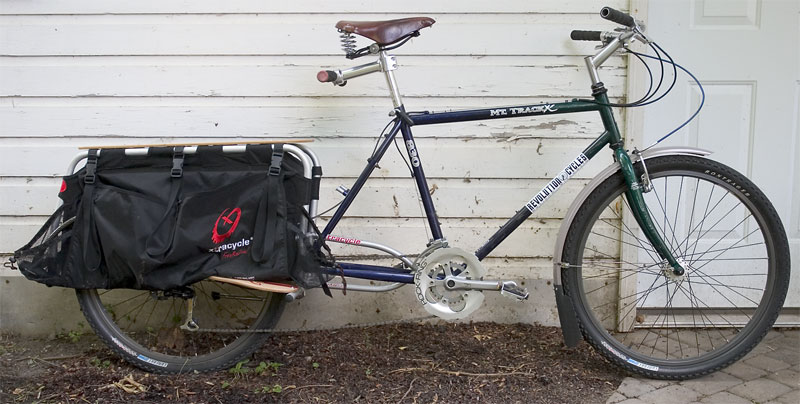
Here she is, the family Xtracycle Free Radical. Her name is Large Marge the Pedal Barge and she's a trash-picked Trek 830 mountain bike frame hooked up to an Xtracycle Free Radical hitchless trailer.


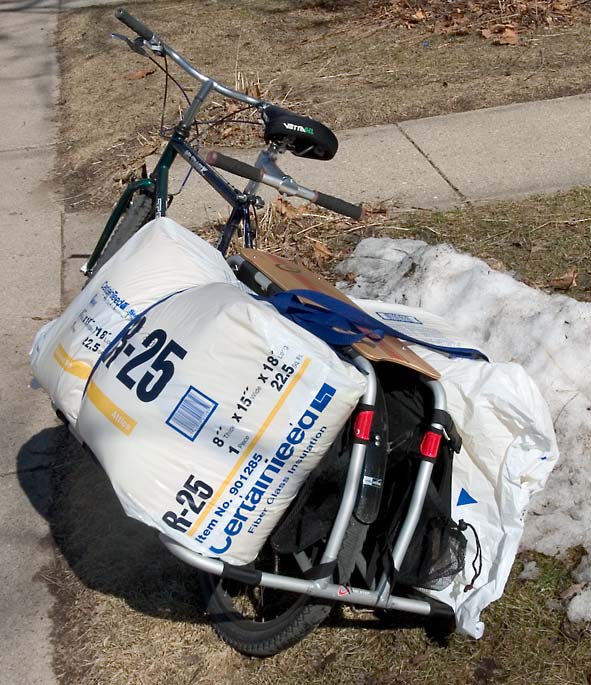
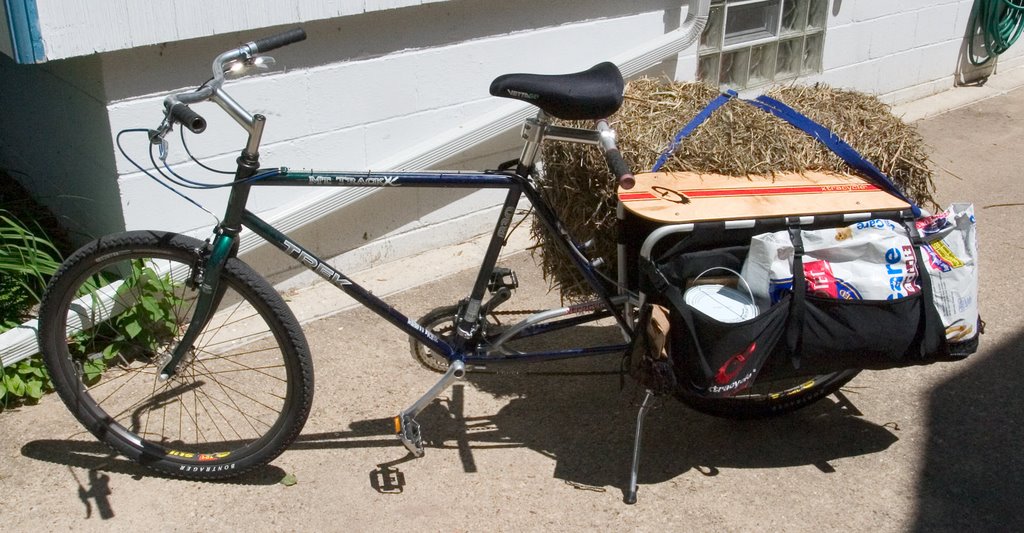
We've had lots of fun with this thing. Besides the countless trips to our community garden space, I've hauled insulation, lumber, paint, dog food, groceries, a bale of marsh hay and a whole bunch of interesting yard sale stuff.


Cargo Bikes

My 15 seconds of fame began late last week when the Sustainable Times, a local treehugger publication, ran an article containing a profile of our family's use of an Xtracycle Free Radical. They have no Web presence at all (which is unfortunate, because they really have a good thing going in print) so I am publishing the article in its entirety here:

Cargo Without the Car


by Robert Allen

Another time. Another war. And Americans were asking themselves “Is this trip really necessary?”

Supporting the troops during the Second World War meant more than slapping a sticker on the car. It meant thinking twice before driving that car.

Years later, I remember hearing my grandparents and parents asking the question, even as cheap gas and Detroit muscle were making car use as reflexive as breathing for most Americans.

The question seemed quaint then. It’s not so quaint today.

Another war. Uncertain oil supplies. Climate change. Gridlock. Obesity. Take your pick. There’s more than one reason to begin questioning the necessity of car trips.

The bicycle provides an obvious way to make unnecessary many trips that once were made in a car.

But many of us who already use a bicycle to get ourselves to work or around town now and then still hop in the car to haul groceries or other household goods. We’re willing to carry ourselves on bicycles, but get flustered by the challenge of carrying much else.

A few years ago, I began rediscovering the types of bags and racks I knew as a kid, relatively modest ways to carry a few things on a bicycle. As a recovering racer, it’s taken me a long time to overcome the racer’s weight fetish for the sake of such practicality.

But the payoff of using even a modest bag or rack is an immediate improvement in the enjoyment of almost any ride. Having a place to shed or acquire layers of clothing helps cope with changing weather, and this stretches the riding season. Food, maps, tools, a spare inner tube or camera are pretty handy to have around.

A decent sized bag, basket or rack means a rider can suddenly run more errands. But even the big old saddlebag on my three-speed quickly reaches its limit, long before I can cross a grocery run off the necessary list.

The real limit, though, is only of one’s imagination. A growing number of riders are finding ways of increasing their carrying capacity to a point where the car is much less necessary in their lives.

One such rider is Michael Lemberger, a Madison graphic artist who currently is adding a second Xtracycle cargo bike to his family’s stable. A little over a year ago, Lemberger converted one of his bikes using an Xtracycle kit. He’s now converting another bike for his wife Gloria, a ceramic artist.

The conversion kit moves the rear wheel back 15 inches, stretching the bike to accommodate an impressive array of bags and carrying surfaces. The extra length has obvious benefits, while allowing a rider to carry wide loads without hitting the load with his or her heel on the backstroke of the pedaling motion.

Lemberger has carried many bags of groceries on his “long bike”. He’s come back from building supply centers carrying everything from insulation to two-by-fours. He’s added some handlebars to his rig so his 7-year-old daughter Olive can enjoy riding in back.

For the sake of a photograph, he strapped on two 55-gallon barrels (though sanity took hold before we tried to fill them up to truly test the manufacturer’s suggested weight limit).

An Xtracycle’s claimed cargo capacity is about 200 pounds. Add a rider and the total ballast you might try to pedal up a hill would be about 400 pounds. Lemberger hasn’t tested that limit, though he says a loaded Xtracycle is surprisingly stable.
Xtracycle kits are available in some Madison shops, as is installation services for the less mechanically adventurous. You can learn more at www.xtracycle.com. Or check out www.rideyourbike.com/xtracycle.html for a gallery of longbike riders carrying amazing loads.

Of course, there are other ways to increase your bicycle’s carrying capacity. Many riders, from long-distance touring cyclists to local grocery haulers, favor any of the increasingly sophisticated trailers on the market. Visit www.bikesatwork.com for one Iowa maker’s take on trailers.

One advantage of a trailer is that you can disconnect it easily to lighten up your machine when not carrying cargo.
Another advantage is that trailers keep the weight of the load off the bicycle, allowing the bike to use much lighter wheels than would be required for carrying heavy loads. Lighter wheels help a bicycle feel much more responsive because light wheels have less rotational weight for a rider to propel. This is why racing bike builders, while always concerned about the overall weight of the machine, go to especially extreme lengths to shave grams off the wheels.
Lemberger, however, likes the feel of two wheels. He believes two wheels, even if relatively heavy wheels, create less rolling resistance than the four wheels of a bicycle and trailer rig.

Of course, trikes are yet a third option, allowing a large cargo carrying space behind the rider between the back wheels. See some classic workhorses as www.worksman.com.

Two, three or four wheels, isn’t the issue. There are many ways to increase self-propelled carrying capacity and decrease reliance on motor vehicles. People in other parts of the world, especially where cars aren’t even an option, are well familiar with many cost-effective options.

At about $400, an Xtracycle kit isn’t exactly cheap. But if it decreases your reliance on a car enough, it will pay for itself rather quickly.

Lemberger isn’t a purist. He and his family of three still own a car. “We’re not car free,” he said. “But we’re car-light.”
Of course, that puts them far ahead of many of us, including your author. And this is what got me thinking of that quaint old question about what trips truly are necessary.

Reducing dependence on the automobile is more about attitude than equipment. It also requires a certain degree of fitness and physical abilities that are not universally shared.

But for those with the needed physical abilities, which includes a vast number of today’s car addicts, a real commitment to reducing auto use will inevitably carry with it the benefit of increasing fitness. Increase fitness enough and you, too, could be testing yourself to see how much cargo you can haul up that hill from the grocery store.

Don’t start out with bags of cement or 55 gallon barrels. Think about smaller errands carrying items you could fit in a small bag or even a large pocket.

“You have to wonder how many car trips are made that could be done on a bike or by walking,” Lemberger said. “There are an awful lot of car trips made to return a DVD or a library book.”

Are those trips really necessary?

Allen is a commuting and recreational bicycler who lives in Middleton.


Yes, that's me, riding down the street with two empty plastic 55 gallon drums strapped to the Xtracycle. Such an unusual sight that I've gotten a call from a reporter at another, larger, mainstream local paper. I'll post something about that article after it runs.

I've also been confirmed as the official family eccentric, a title I wear with pride.